
 Our Work
A Tale of Two Cities: The Divide Between Front of House and Back of House
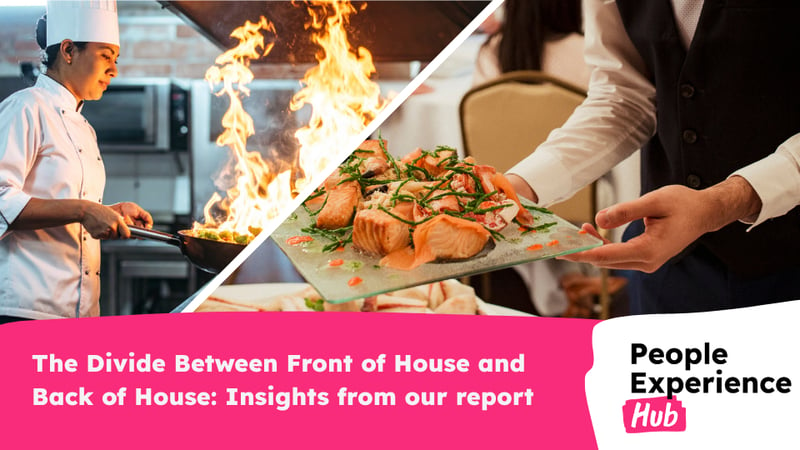
In hospitality, FOH and BOH are two sides of the same coin, but too often, they’re living in different worlds. And when the people who must deliver a seamless customer experience have fundamentally different work experiences, the cracks don’t stay hidden for long.
The data from our Hospitality Culture Report makes this clear:
Front of House and Back of House do not experience the workplace in the same way.
Two Cities. Two Realities.
Back of House
BOH teams report a stronger focus on solving problems (+9.2pp), feel more able to raise ethical concerns (+9.4pp), and are more likely to recommend hospitality as a great industry to work in (+16.3pp).
But they also face real barriers:
- Lower belonging (-5pp)
- Systems and tools (-12.5pp)
- Lower inclusion, especially around “being different is not a barrier to success” (-12.9pp)
*Scores compared to FOH
Front of House
FOH colleagues score higher on:
- Wellbeing (+5.2pp)
- Workload balance (+8.5pp)
- Feeling respected and cared for by their manager (+5pp)
But FOH teams also report:
- Less clarity on performance objectives (-11.6pp)
- Less likely to recommend hospitality as a great industry (-16.3pp)
Two groups, two experiences, one customer.
Why This Matters
You cannot deliver a brilliant customer experience with a divided workforce.
- FOH creates the moment.
- BOH makes the moment possible.
When BOH tools don’t work, FOH suffers.
When FOH feels disconnected or unclear, service slows down.
When belonging is uneven across teams, culture fractures.
And the customer, who sees all of this instantly, feels it.
The Real Risk? A Quiet Drift Apart
Left unchecked, these differences harden into silos, silos become frustrations, frustrations become friction, and friction becomes turnover.
And turnover is expensive, financially, emotionally, and operationally.
What Great Operators Do Next
This divide isn’t a given, it’s a leadership opportunity.
What high‑performing operators can do:
1.Create shared purpose
Bring FOH and BOH into the same story: the guest experience.
2.Fix the friction
Audit the systems and tools BOH rely on.
Fix clarity and communication gaps that FOH keep calling out.
3.Recognise both worlds
Celebrate the heroes in the kitchen as much as the heroes on the floor.
4.Cross‑train to build empathy
A FOH shift in BOH and a BOH shift in FOH can change everything.
5.Raise the floor, not just the ceiling
Belonging, inclusion, and psychological safety must be consistent for everyone, not just one part of the team.
These are basics, the hygiene factors of the role people play at work.
One Team. One Experience. One Outcome.
The customer doesn’t care whether a great experience came from FOH or BOH, but they do feel the difference when those teams aren’t aligned.
A tale of two cities becomes a tale of one culture when leaders close the gaps, unite the teams, and build an environment where everyone can deliver their best.
Because hospitality isn’t FOH or BOH - It’s both, or it’s nothing.