 Our Work
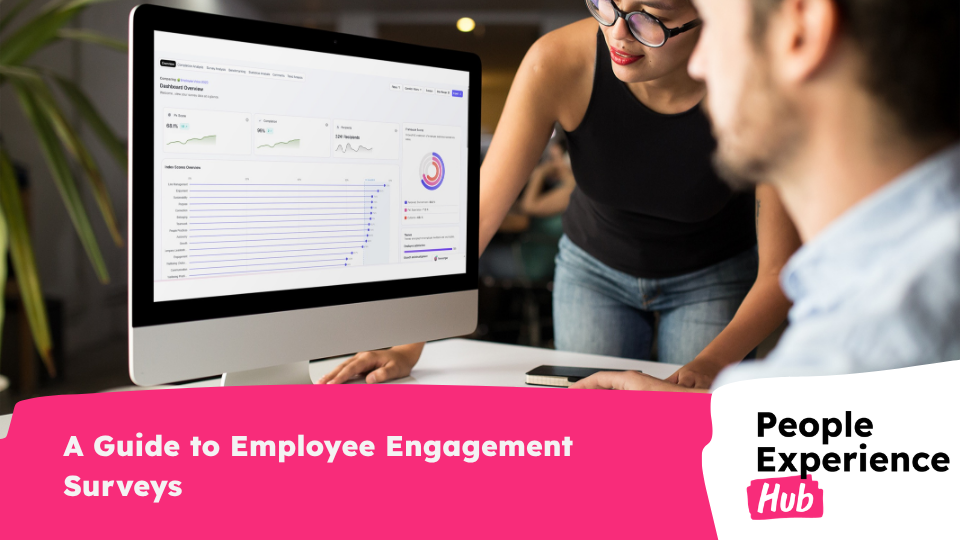
Whether you're launching your first employee engagement survey or refreshing your knowledge of best practices, this comprehensive guide will take you confidently through the entire process. Designed for HR professionals, managers, and business leaders, you'll learn all the fundamentals from why engagement surveys are important to how to conduct, design, and analyse them effectively - while avoiding common pitfalls.
What Is an Employee Engagement Survey?
An employee engagement survey is a structured way for organisations to understand how committed people feel to their work and their organisation - and the conditions at work that shape that commitment.
Rather than simply asking whether people are satisfied or capturing surface-level opinions, engagement surveys look deeper at the experiences, needs and workplace factors that drive emotional investment. The goal is not just to measure engagement, but to understand what strengthens or weakens it, so organisations can improve the work environment in ways that genuinely matter to people.
These surveys typically consist of carefully crafted questions designed to assess various dimensions of the employee experience, including people management, leadership, relationship with managers, opportunities for growth, work-life balance, and the team environment. The responses provide organisations with quantifiable data about workforce sentiment, revealing both strengths to celebrate and areas requiring attention.
Employee engagement surveys can take various forms, from comprehensive annual assessments with 50 or more questions to shorter pulse surveys conducted quarterly or monthly. We’ll come back to that, because it’s important to ensure that the type or mix of surveys that you use is will help you meet your objectives.
The Purpose of Employee Engagement Surveys
Employee engagement surveys are important because they serve multiple interconnected purposes that extend far beyond simple data collection. At their core, organisations conduct these surveys to gain actionable intelligence about workforce sentiment, identifying specific factors that drive or hinder employee commitment, so that the organisation’s leadership make better decisions, develop people strategies and improve the culture. That requires a diagnostic tool that reveals not only how engaged people are and where improvements can be made, but what is likely to motivate them.
Beyond measurement, surveys serve an important symbolic purpose by demonstrating that leadership values employee opinions and is committed to listening. This creates a direct communication channel that surfaces insights which might never emerge through traditional feedback mechanisms. Ultimately, the overarching objective is to establish a continuous feedback loop where employee input directly shapes workplace improvements - informing strategic decisions about everything from leadership development and compensation to workplace policies and career advancement opportunities. When executed effectively, this cycle of listening and action drives engagement, performance and organisational success.
What are the Benefits of an Employee Engagement Survey?
Employee engagement surveys provide a unique opportunity to develop or assess the effectiveness of people strategies, and can deliver tangible benefits that extend across all levels of an organisation.
These include:
Business Performance
- Higher productivity, profitability, and customer satisfaction scores
- Increased innovation and collaboration
- Greater discretionary effort that drives competitive advantage
Talent Retention
- Proactively identify and address issues before employees leave
- Reduce costly turnover (replacing an employee typically costs 50-200% of their annual salary)
- Protect your investment in human capital by resolving engagement issues early
Communication and Trust
- Give employees a voice and create constructive dialogue between staff and leadership
- Build trust through transparent sharing of results and action plans
- Strengthen the psychological contract by demonstrating that feedback is valued and acted upon
Strategic Resource Allocation
- Target interventions where they'll have the greatest impact
- Replace blanket programs with data-driven initiatives that address real needs
- Invest in the right areas. For example, if career development is a top concern, prioritise mentorship and training rather than initiatives that won't move the engagement needle
Types of Employee Engagement Surveys
Organisations have several survey formats to choose from, each serving different purposes and offering distinct advantages:
Annual or Comprehensive Engagement Surveys: these represent the traditional approach, typically conducted once per year with extensive question sets covering all aspects of the employee experience. These surveys provide deep, holistic insights and allow for year-over-year trend analysis. They also tend to attract higher participation rates as it’s easier for people to get behind an annual event than something that happens more often. However, their infrequency means organisations may miss emerging issues, and the length needs managed carefully, as it can lead to survey fatigue.
Explore more on employee engagement surveys
Pulse Surveys: have gained popularity as a complement or alternative to annual surveys. These shorter questionnaires usually contain 5-15 questions and are administered more frequently - monthly, quarterly, or even weekly. Pulse surveys allow companies to track engagement trends in near real-time, quickly gauge reactions to organisational changes, and maintain ongoing dialogue with employees. Their brevity can make them more attractive, though they sacrifice depth for frequency.
Explore more on pulse surveys
Lifecycle Surveys: track the employee journey across key touchpoints including onboarding, promotions, manager chances, leaving and other significant moments. By gathering feedback at these critical junctures, organisations can understand how specific experiences impact engagement and make targeted improvements to high-stakes transitions.
Explore more on lifecycle surveys
Specific examples of lifecycle include -
Onboarding Surveys: focus specifically on new hire experiences, typically administered at thirty, sixty, and ninety-day intervals. These surveys assess how well new employees are integrating, whether they have the resources and support needed to succeed, and if their actual experience matches recruitment expectations. Early identification of onboarding issues helps organisations reduce new hire turnover and accelerate time-to-productivity.
Exit Surveys and Stay Interviews: represent bookend approaches to understanding engagement. Exit surveys gather feedback from departing employees about their reasons for leaving, providing candid insights that current employees might hesitate to share. Stay interviews flip this concept, proactively asking valued current employees what keeps them with the organisation and what might cause them to leave, allowing leaders to address concerns before turnover occurs.
How to Conduct an Employee Engagement Survey?
Conducting an effective employee engagement survey requires careful planning and execution across multiple phases.
1. Define Clear Objectives: Start by determining what you want to learn, what decisions the data will inform, and how you'll use the results. Without clear purpose, surveys become unfocused exercises that overwhelm employees but yield little actionable insight.
Ideally, these objectives would be set as part of a wider employee listening strategy that identifies key objectives, stakeholders and themes before you even consider what mix of surveys (and other listening approaches) you will use.
2. Design Your Survey: Balance comprehensiveness with brevity by selecting questions that align with your objectives and are validated to measure engagement. Use a combination of standardised questions (for external benchmarking) and custom questions (for organisation-specific priorities). Ensure all questions are clear, unambiguous, and free from leading language.
3. Communicate Before Launch: Maximise participation by explaining why you're conducting the survey, how results will be used, what confidentiality protections exist, and when employees can expect results and actions. Leadership endorsement through emails, town halls, or videos signals the survey's importance.
4. Administer The Survey: Make the process frictionless by ensuring accessibility on multiple devices and availability to deskless workers (for example using posters and QR codes), sending reminders to non-respondents, and monitoring response rates by department or demographic to identify groups needing additional encouragement.
5. Analyse Results: Look beyond overall scores to identify patterns across departments, tenure groups, or demographics. Use statistical analysis to reveal which factors most strongly correlate with engagement (these are “drivers of engagement”), analyse text comments and compare your results against industry benchmarks, if desired.
6. Communicate Results Transparently: Share overall findings with the entire organisation, then provide managers with team-specific data for group discussions. Be honest about both strengths and weaknesses as sugarcoating problems undermines credibility and implies that you don't truly value employee input.
7. Develop and Execute Action Plans: Prioritise areas with the greatest impact and feasibility for improvement. Assign clear ownership, set timelines, establish progress metrics, and regularly update employees. Be prepared to explain why certain issues may take longer to address or can't be resolved exactly as employees suggested.
Research suggests that managers who take action can see improvements of around 20% in overall results over time, while those that also discuss their results with their teams see around 30% improvement. This won’t happen on its own, and it takes organisational effort to equip and enable managers to make sense of and act on their results, though bridging this data-action gap is one area where AI can make a real difference.
Employee Engagement Survey Questions
Effective survey questions are clear, concise, and designed to elicit honest responses that provide actionable insights. Each question should address a single concept rather than compound ideas that force respondents to agree or disagree with multiple statements simultaneously. For example, “My Line Manager cares about me and communicates well” means having to think about two separate aspects of line management, whereas “My Line Manager cares about me and my wellbeing” is broadening the definition of care as a single topic.
Avoid negatively worded questions which can confuse respondents and reduce data quality. Use consistent language throughout - if you use "company" in some questions and "organisation" in others, respondents may wonder if you're referring to different entities.
The best engagement surveys include a mix of question types that measure different dimensions of the employee experience. Questions typically fall into several categories that explore different aspects of engagement. A few common examples are set out below, but a full (annual) survey can explore topics including workplace safety, processes and systems, sustainability – and not just “people stuff” – as they can all impact engagement.
Questions Assessing Organisational Alignment or Purpose: "I understand how my work contributes to the company's goals," "I believe in the mission and values of this organisation," or "Senior leadership communicates a clear vision for our future." These questions reveal whether employees connect their daily work to larger purposes.
Manager Relationship Questions: Crucial since the immediate supervisor relationship is often the strongest predictor of engagement: "My manager provides regular, constructive feedback on my performance," "I trust my manager to support my career development," or "My manager creates an environment where I can do my best work."
Recognition and Appreciation Questions: Assess whether employees feel valued: "I receive recognition when I do good work," "My contributions are appreciated by my team and leadership," or "The organisation celebrates both individual and team successes."
Career Development Questions: Explore growth opportunities: "I have opportunities to learn and grow in my role," "I can see a career path for myself at this organisation," or "The company invests in employee development and training."
Work-Life Balance and Well-Being Questions: Have become increasingly important: "I am able to maintain a healthy balance between work and personal life," "I feel supported in managing stress and maintaining my well-being," or "The workload I'm given is reasonable and sustainable.
While the purpose of this blog is to help anyone that wants to run an employee engagement survey, we have our own framework, Think, Feel, Do which separates what we describe as the think, feel and do of employee engagement. The main reason for this is that it enables us to analyse not only what is driving engagement (the “think” or Perceived Environment) but how (the “feel” or Felt Experience) and this opens up new opportunities for people strategies.

Also bear in mind that scale selection significantly impacts data quality and analysis options. Our recommended approach is a five-point Likert scale ranging from Strongly Disagree to Strongly Agree, with a neutral midpoint. Some organisations use six, seven, or even eleven-point scales to increase granularity, while others eliminate the neutral midpoint to force respondents toward agreement or disagreement. Each approach has merits; consistency matters more than the specific choice.
Open-Ended Employee Engagement Survey Questions
While quantitative ratings provide measurable data, open-ended questions offer rich, qualitative insights that numbers alone cannot capture. These questions allow employees to explain their ratings, share specific examples, and raise issues that standardised questions might miss.
Effective Open-Ended Questions Include:
"What is the most important thing that could be improved about working here?" This broad question surfaces employees' top priorities without constraining their thinking.
"What do you enjoy most about working here?" helps identify organisational strengths that might otherwise be taken for granted.
"What would make you more effective in your role?" focuses on practical barriers to performance.
"If you could change one thing about your team or department, what would it be?" allows for more targeted feedback than organisation-wide questions.
Keep open-ended questions to a minimum, typically three to five at most, since they require more effort to complete and more time to analyse, although this is becoming easier with AI (and this might change how we design surveys in future).
Place them logically within the survey – for example if an open ended question is about leadership put it with other leadership questions. It might make sense to keep more general open questions back until the end of the survey, but consider the length of the survey and potential for fatigue.
Bear in mind that open questions are generally there to add context to quantitative results: If you need further qualitative insights, use qualitative methods such as interviews and focus groups, where you have more control over delivery of responses.
Analysing Open-Ended Questions
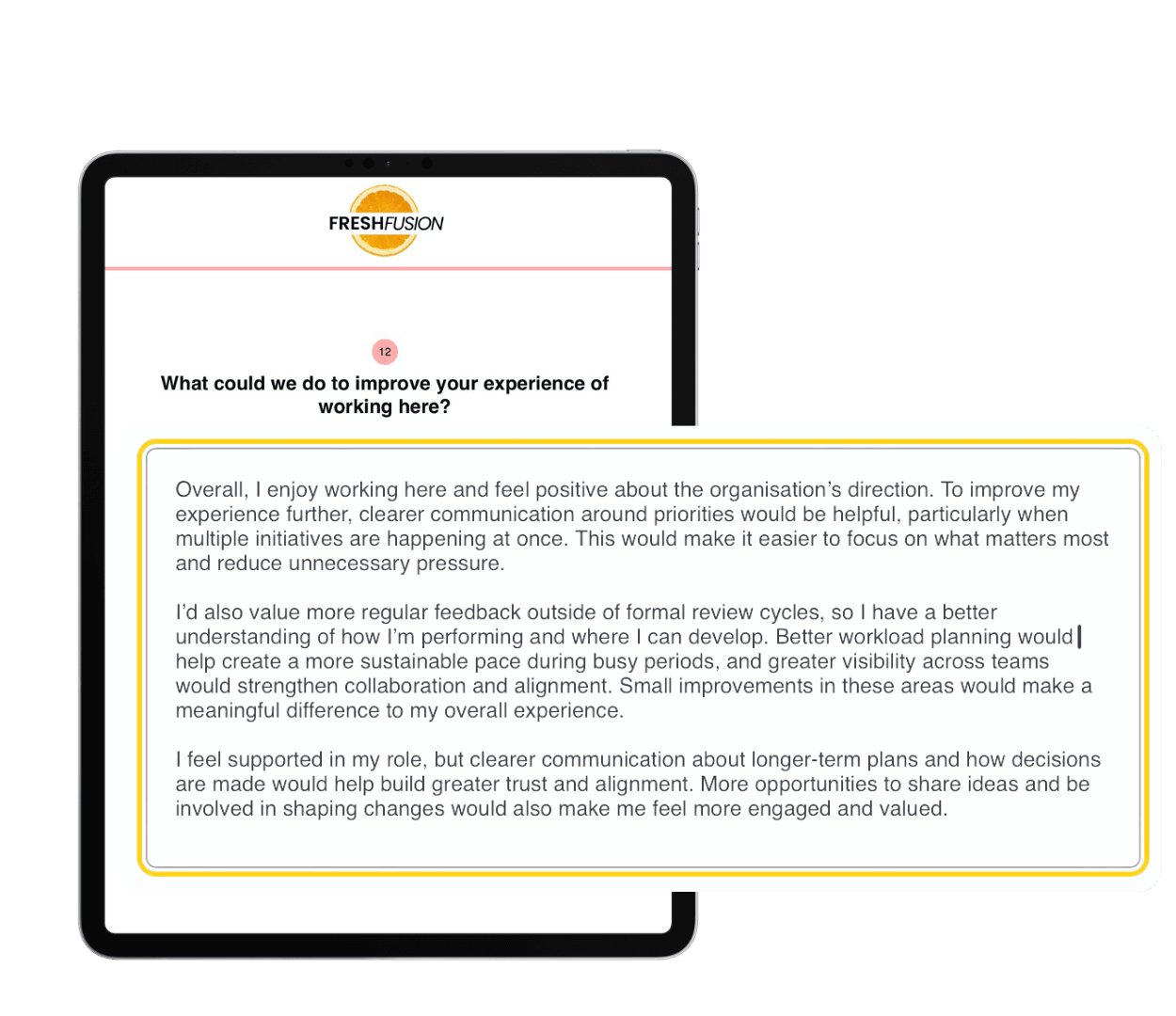
It’s also important to think about how open‑text comments will be analysed. If comments need to be reviewed manually, using a higher number of more focused, topic‑specific questions can make analysis easier. Where AI‑driven thematic analysis is available, this level of structuring is less necessary, as themes can be identified across fewer, broader questions.
Question design also affects sentiment analysis. Paired positive and negative prompts such as “What do you enjoy?”and “What could be improved?” can distort sentiment signals, as they lead respondents in a particular direction. If understanding overall sentiment is important, a more open invitation for additional comments can be more effective. Alternatively, if the practical value of directional questions is preferred, it makes sense to de‑emphasise or exclude sentiment analysis altogether.
Remote Employee Engagement Survey Questions
The rise of remote and hybrid work has created unique engagement challenges that may require specific survey questions. Remote employees face distinct issues around isolation, communication, work-life boundaries, and access to resources that traditional office-based questions might not capture.
There are different ways of handline remote workers, however. If you know in advance who is a remote worker you may be able to include this in the demographic data that you load onto your survey platform and compare remote and physically located workers responses directly. If you have questions that are only relevant to remote workers you can use question routing to ensure that no-one is asked irrelevant questions.
If you prefer to address remote-specific questions explicitly these could include:
- Connection and Belonging: "I feel connected to my team despite working remotely," "I have adequate opportunities to build relationships with colleagues," or "I feel included in important conversations and decisions." These questions assess whether physical distance has created social distance.
- Communication and Collaboration Questions: become more critical for remote teams: "I have the tools and technology I need to collaborate effectively with my team," "Communication from leadership is clear and timely," or "I can easily reach people when I need help or information."
- Questions About Manager Support in Remote Contexts: you might include: "My manager is effective at leading our remote/hybrid team," "I receive enough guidance and direction while working remotely," or "My manager trusts me to manage my own time and work."
- Work-Life Boundary Questions: take on new dimensions with remote work: "I am able to disconnect from work during off-hours," "The organisation respects boundaries between work time and personal time," or "I have a suitable workspace that allows me to be productive."
How to Design an Employee Engagement Survey
Good survey design is critical to the quality of your results, the level of insight that you can draw from them and, consequently, the impact that resulting actions or initiatives will have on the employee experience and engagement.
When planning your employee survey, you might be tempted to use a pre-built template off the shelf. Many survey providers will insist their model is the "best" or the industry standard you must follow. However, there's no gold standard for measuring employee engagement, and research on what drives it provides inconsistent results across different organisations.
This is why relevance is critical. The most effective surveys are those tailored to your specific context aligned with your people strategy, organisational values, and desired culture. While standardised question sets can provide a helpful starting point to avoid the blank page, they should be customised to measure what truly matters in your unique workplace. Use your judgment to select measures that will provide insights you can actually act on, rather than generic data that may not reflect your organisation's reality.
We have a range of survey templates, including employee engagement, that you can use but we encourage you (and can support you) to use them as a starting point and make them your own.
Survey flow affects completion rates and response quality. Start with easier, less sensitive questions to build momentum before addressing more challenging topics. Group related questions together thematically rather than jumping between topics, which can disorient respondents. Place demographic questions at the end since they're straightforward to answer even if fatigue sets in.
Define Your 'Why'
Before launching a survey, clarify why you're really doing this (and if you’re thinking about your listening strategy, how it fits in with your broad objectives). If it's simply to report a metric in the annual report, you're missing the opportunity. Ask yourself what you truly want to understand:
- Assessing Practices: Are you evaluating your organisational culture, policies, or management approaches?
- Understanding Feelings: Do you want to know how employees actually feel day-to-day at work?
- Measuring Outcomes: Are you tracking specific success metrics like readiness for change, innovation capability, or retention risk?
Your answers will shape not only what you measure but also whether a full company-wide survey is even the right tool. Depending on your goals, you might be better served by:
- Pulse Surveys to track specific issues or metrics over time, or to explore a theme in a more targeted way
- Event-Driven Surveys like onboarding or exit interviews to capture experiences at critical moments
- Qualitative Research such as interviews or focus groups for deeper exploration of complex issues
Don't assume a comprehensive engagement survey is always the answer. Start with your objectives, then choose the approach that best serves them.
Define Your 'What': Themes and Indices
Once you've clarified why you're running your survey, determining what to measure becomes clearer. You might say you want to measure "engagement," but as the CIPD notes, employee engagement is such a broad concept it essentially encompasses your entire people strategy. You need to be more specific.
This is where your people strategy, organisational values, and cultural aspirations become invaluable reference points. Use them to identify the specific themes that matter most to your organisation. If these frameworks aren't yet in place, don't worry discussions about your business strategy or focus groups with stakeholders can help surface the right themes. In fact, your survey results can then help you develop these strategic elements.
Organising Around Themes
These themes sometimes called indices form the foundation of your survey structure. Each theme represents a key dimension of the employee experience, and your questions are organised around them.
The themes that we tend to use in our engagement survey are organised according to our Px3 framework (think, feel, do) and include:
Think (Perceived Environment) Themes:
- Company Leadership (clarity of mission/vision, trust, confidence in direction)
- Line Management (supportiveness, care & respect, performance management)
- Communication (regularity, openness and honesty, change communications)
- People Practices (L&D opportunity, reward & recognition, policies, inclusion)
- Sustainability (environmental, community)
- Organisational Effectiveness (systems, processes, ways of working)
- Wellbeing Practices (safey, support for wellbeing, workload)
Feel (Felt Experience) Themes:
- Belonging (inclusion, psychological safety)
- Growth (development opportunities, career progression, learning)
- Autonomy (freedom to act, trusted, ability to influence)
- Purpose (organisational pride, meaningfulness, connection with goals)
- Enjoyment (general enjoyment, lack of distraction, time flies)
- Connection (quality of relationships, emotional support)
Do (People Outcomes) Themes:
- Engagement (intention to stay, advocacy, motivation)
- Wellbeing (Stress, Burnout, Thriving)
Ultimately, however, you will choose themes that align with what your organisation genuinely wants to understand and improve, not just what we or any other survey provider says!
Present Your Survey Clearly and Accessibly
Survey presentation directly impacts response quality. A confusing or fatiguing survey leads to two problems: people either abandon it entirely or, worse, click through mindlessly just to finish. Neither scenario gives you reliable data.
Design for Accessibility
Consider potential barriers that might prevent honest, thoughtful responses:
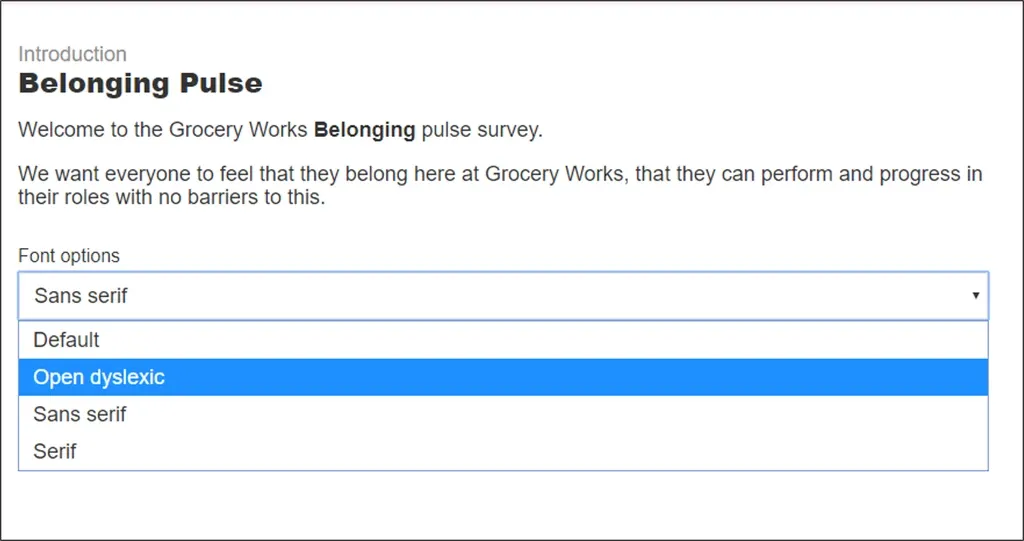
- Neurodiversity: Ensure your design accommodates conditions like dyslexia through clear fonts, adequate spacing, simple language and design for colour blindness
- Language Barriers: Use plain, straightforward wording and offer translations where needed
- Cognitive load: Keep the interface clean and navigation intuitive
Avoid Gimmicks
While interactive elements like sliders or animated rating scales might seem engaging, they often create more problems than they solve. These features prioritise visual appeal over usability and can actually increase cognitive load or create accessibility issues. Stick to simple, proven survey design elements such as; radio buttons, drop-down menus, and text boxes work because they're familiar and accessible.
Good survey design is about substance, not theatre. Your goal is to make it as easy as possible for employees to share their genuine opinions, not to impress them with flashy features.
Pilot Test Before Launch
You may wish to pilot test your survey with a small group before full deployment, and this can even be done with a preview version. Ask pilot participants to think aloud as they complete it, noting confusing questions, technical issues, or unexpected interpretations. Even five to ten pilot respondents can catch problems that would otherwise undermine your entire survey effort.
Using Demographic Data in Employee Surveys
When you run your survey you have two basic choices when it comes to demographic and organisational data: Load demographics up front or ask for them in the survey. Ultimately this depends on the quality of data that you hold, the capability of your platform to use it, and the security of your platform.
When choosing an employee survey provider, data security should be a minimum requirement so lets’ focus on your data and the capability of the platform.
Why Would You Share Your Data With a Survey Platform?
Simply put, by loading information that identifies each recipient, including their email address and where they sit in your ‘hierarchy’, you can automatically send them a personalised link and ensure that their results are accurately placed into the right divisional or departmental structure. The same is true for their personal demographics, including length of service, age, gender, sexual orientation, disability and so on.
We find that some organisations do not hold sensitive data or are nervous about sharing it. However, GDPR exists not to stop you using data effectively, but to ensure that it is used appropriately. What better use is there than targetting strategies to improve the experience of different employees and ensuring that your organisation is inclusive?
You may not have consistently high quality demographic data, and therefore may need to collect it as part of the survey. These responses can then be used to analyse the data but beware: People may choose to lie if they don’t trust you, may answer inaccurately in error, and you will be increasing the load on participants.
We would recommend that even if you start by collecting demographic data through the survey itself, you embark on a data collection and cleansing process, not only to support your surveys but also because you are likely to have to report more on pay gaps, for example, in future.
What Affects Employee Survey Participation?
Assuming your survey questions are well-designed, several factors can impact participation rates and completion:
Lack of Trust
When trust is low, employees may not feel safe giving honest opinions, even on genuinely anonymous surveys. There's no shortcut to building trust, but using an external provider that's seen as independent can help demonstrate your commitment to confidentiality.
Under-Communication
Change guru John Kotter famously stated that change tends to be under-communicated by a factor of 10. We consistently underestimate how much communication is needed. The survey may be front of mind for you, but not for everyone else. Multiple touchpoints through various channels are essential to drive awareness and participation.
Lack of Visible Leadership Sponsorship
Communication matters, but visible commitment from senior leaders is equally important. Employees need to see that the survey matters to leadership, not just HR. This sponsorship must be reinforced throughout the management chain, all the way to frontline supervisors. It is, however, important that support and encouragement doesn’t become pressure or even coercion as this will impact upon the quality of your results. We have seen survey participation being used as a management KPI, but we’d caution against that for the same reasons.
Survey Fatigue and Low Motivation
Survey fatigue can stem from running too many surveys, but more often it reflects cynicism or lack of belief that opinions are valued due to inadequate follow-up on previous surveys. If this is the case, acknowledge it directly and demonstrate commitment to action this time. It’s worth taking the time to build a feedback culture one survey at a time.
Technical Issues and Barriers
Simple planning oversights can create significant barriers: lack of email access for frontline workers, browser compatibility issues, surveys caught in spam filters, or poor mobile optimisation. All of these are avoidable with proper testing and planning.
Why People Start But Don't Finish
When employees begin but abandon surveys midway, it's typically due to poor survey design: too many questions, ambiguous wording, confusing presentation, or system errors. Pilot testing can identify and resolve these issues before launch.
Employee Engagement Survey Analysis
Effective analysis transforms raw survey data into actionable insights that drive organisational improvement. Here's how to approach it:
1. Start with Descriptive Statistics: Begin with the basics: overall engagement scores, response rates by department or demographic group, and distribution of responses across rating scales. Calculate mean scores for each question and identify your highest and lowest-scoring items.
2. Compare Results for Context:
a. Historical trends: Compare current results to previous surveys to identify whether scores are improving, declining, or stable
b. Internal benchmarks: Compare departments, countries or other demographic groups against the norm to understand how they experience work differently to others.
c. External benchmarks: Compare against industry standards or competitor data if available, but recognise that different organisations may use different questions or methodologies, limiting direct comparisons
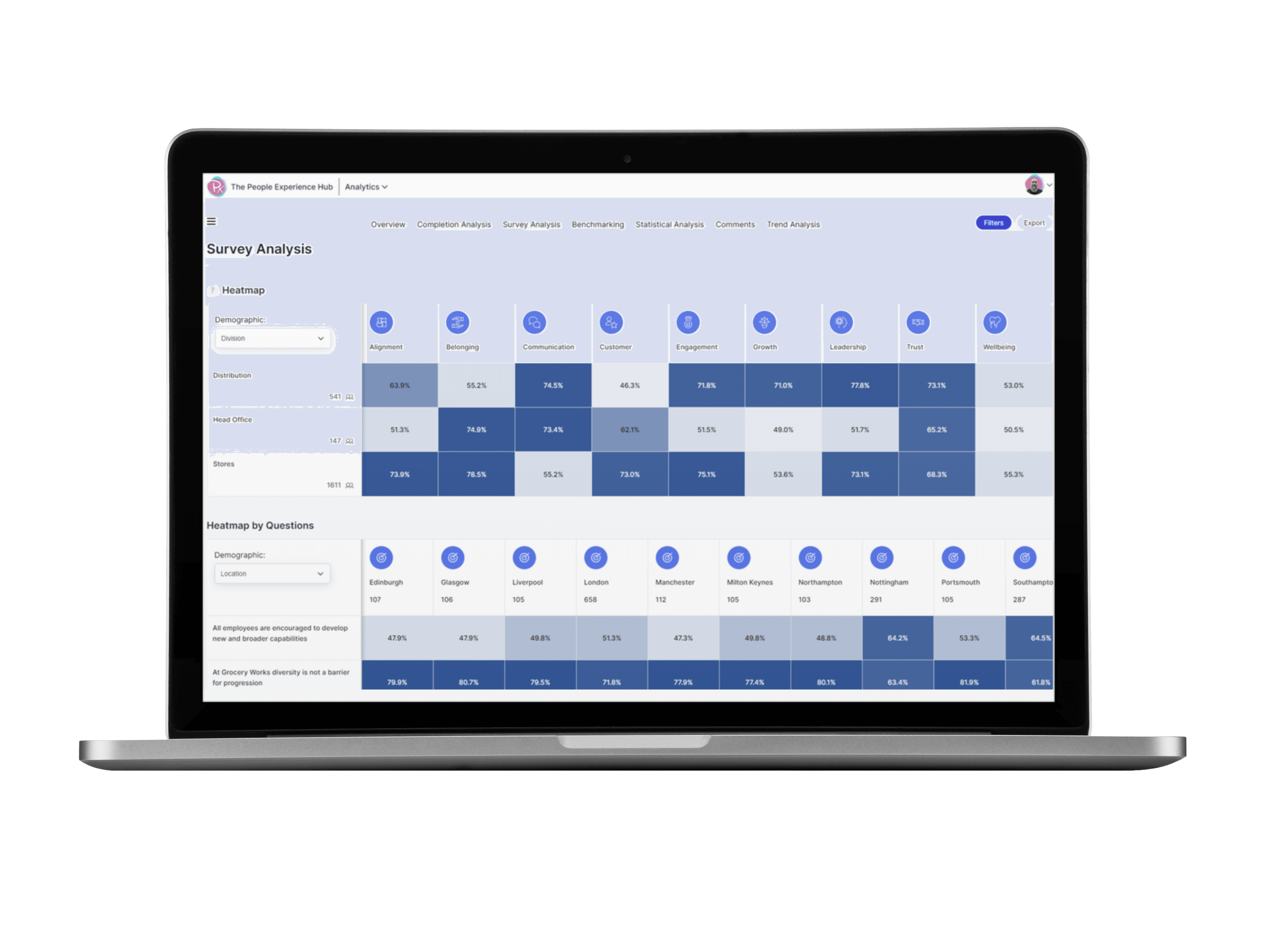
3. Analyse Demographic Breakdowns: Examine heatmaps by department, location, tenure, role level, or other relevant categories to identify pockets of high or low engagement. This reveals whether engagement varies across different employee groups. Always ensure demographic segments contain at least five to ten respondents to maintain confidentiality. This is useful in identifying which groups you want to explore further using internal benchmarking.
4. Conduct Driver Analysis: Use statistical techniques like correlation or regression to identify which factors most strongly predict overall engagement. This helps prioritise improvement efforts by revealing which issues have the greatest impact. For example, you might discover that career development opportunities correlate more strongly with engagement than compensation, showing you where to focus resources.
5. Analyse Open-Ended Responses: Qualitative analysis requires different techniques. Read through all comments to identify recurring themes, then categorise responses using a coding scheme. Count how frequently different themes appear to quantify the qualitative data.
This is an area where AI can help enormously, not just analysing the data for theme and sentiment, but also describing the comments that relate to those themes. Our own Px Voice tools are examples of a specialist tool. You can use more generic large language models (e.g. ChatGPT or Google Gemini) but these can provide inconsistent results.
Direct quotes can powerfully illustrate quantitative findings when sharing results, making abstract numbers concrete and relatable.
Measuring Employee Engagement Survey Success
Several metrics help organisations track and evaluate engagement over time:
- Overall Engagement Score/Index: Calculated by averaging responses to a core set of questions, this provides a single summary measure of engagement.
- Employee Net Promoter Score (eNPS): Based on the question "How likely are you to recommend this organisation as a place to work?" A ‘pure’ eNPs approach categorises respondents rating 9-10 as promoters and 0-6 are detractors, and eNPS equals the percentage of promoters minus the percentage of detractors. However, we find that many people who refer to eNPS are simply interested in the core question, however it is scored. Note that you should not use the pure eNPS score when calculating drivers, but instead use the scaled rating.
- Response Rates: Typically range from 60%+ for well-run surveys. Low response rates may indicate survey fatigue, lack of trust that feedback will lead to action, communication failures, or even a lack of history with surveys. Higher response rates are better because they make for more trustworthy results, but only up to the point where people have felt pressured into taking part. Monitor rates across demographic groups to identify participation barriers.
- Favourability Scores: Measure the percentage of employees responding positively to each question (typically "Agree" or "Strongly Agree"). This metric is more intuitive than means for many audiences and helps identify specific questions needing attention.
- Improvement Metrics: Track progress by comparing current results to baselines and measuring action plan initiatives. Celebrate wins when scores increase, but recognise that engagement can decline even when organisations are improving if employee expectations rise faster than organisational change, or if there are broader uncertainties at play.
How to Communicate Survey Results
Communication requires careful planning to build trust, maintain momentum, and set the stage for action.
Timeline Matters
Share high-level results with all employees within 2-3 weeks of survey closure. Delays beyond this suggest the survey wasn't a priority, creates a vacuum that people might fill with their own narrative and breed cynicism.
All-Company Communication Should Include:
- Acknowledgment and thanks for employee participation and candour
- Overall results shared honestly, including both strengths and challenges
- Relevant context and comparisons
- Next steps and timelines for deeper analysis and action planning
- Commitment to ongoing progress updates
Avoid sugarcoating negative results, employees provided honest feedback and deserve honest communication in return.
Cascade to Team Level
Follow organisation-wide communication with team-specific sessions where managers review results with their groups. Provide managers with team data and guidance on facilitating productive conversations about what the data means, which issues to address, and what actions can be taken locally versus requiring broader organisational intervention.
Ideally this cascade would use actual dashboards or reports provided by your provider, as employees might be more inclined to trust them. However, protect confidentiality by not sharing results for groups smaller than your predetermined threshold (typically 5-10 respondents).
Lead with Listening
Throughout the communication process, focus on dialogue rather than defending or explaining away results. Acknowledge employee concerns, appreciate their willingness to share difficult feedback, and demonstrate genuine commitment to addressing issues. Your tone and approach during results communication often matters more than the specific scores themselves in determining whether employees view the survey as worthwhile.
Employee Engagement Survey Pricing
How Much do Employee Engagement Surveys Cost?
Employee engagement survey costs vary significantly based on organisation size, survey frequency, platform capabilities, and the level of support you need. Understanding the pricing landscape helps you budget appropriately and evaluate options but be ready to dig into the detail and understand what you will and won’t get for your money.
General Survey Platforms vs. Specialised Solutions
Basic survey tools like SurveyMonkey or Google Forms offer low-cost options (a few hundred to a few thousand dollars annually) for organisations wanting to run simple surveys. However, these general platforms lack engagement-specific features like validated question libraries, engagement benchmarking, driver analysis, and action planning tools that specialised platforms provide.
Specialised Engagement Platform Pricing
Most employee engagement software providers, including us, use per-employee pricing models with annual contracts. Here's how the market typically breaks down:
Small Organisations (up to 250 employees): SMEs can expect to pay anything from £2,000-£3,000 for a single module or survey, up to around £10,000 annually for a multi-module package including including basic survey templates, analytics, and standard support.
Mid-Sized Organisations (250-2,000 employees): Mid-sized organisations can expect to pay from £10,000-£40,000 annually, at the upper end offering more sophisticated analytics, benchmarking capabilities, action planning tools, and enhanced consultancy support.
Large Enterprises (2,000+ employees): Enterprise platforms can vary as much as the size and complexity of the organisation, starting from around £40,000-£200,000+ per year, providing advanced analytics, dedicated customer success management, bespoke design, consultant-driven reporting, and integrations with HRIS and other systems.
Additional Cost Considerations
Some vendors charge separate setup fees (£2,000-£20,000) for enterprise implementations requiring integrations, custom configurations, or extensive training. Others bundle implementation into annual fees, so it's important to clarify this when comparing vendors and ensure that there will be no surprises further down the line.
Consulting firms that offer engagement survey services typically use different pricing models, often charging per-survey rather than annual subscriptions. Costs range from £5,000 for basic surveys at small organisations to over £100,000 for comprehensive surveys with extensive analysis and action planning at large enterprises.
Average Cost Per Employee
Calculating cost per employee provides a useful perspective for budgeting and comparison. Across the market, typical tech costs range from £5-£50 per employee annually, varying significantly by organisation size, number of products/modules and service level:
- Small organisations: £15-£50 per employee (higher due to minimum fees and lack of volume discounts)
- Mid-sized organisations: £10-£20 per employee (better economies of scale)
- Large enterprises: £5-£15 per employee (lowest per-employee costs, though total contract values are substantial)
These per-employee costs typically cover the survey platform, basic analytics, and standard support. Advanced features like bespoke analysis, exec presentations, custom question development, or action planning consulting may incur additional fees. Budget an extra 15-25% beyond base platform costs if you anticipate needing these services.
Don't Forget Internal Costs
When calculating true costs, factor in internal resources required. Staff time for survey design, communication, analysis, and action planning represents a significant investment that's often overlooked. Organisations new to engagement surveys frequently underestimate these internal resource requirements, which can equal or exceed the platform costs themselves.