
 Our Work
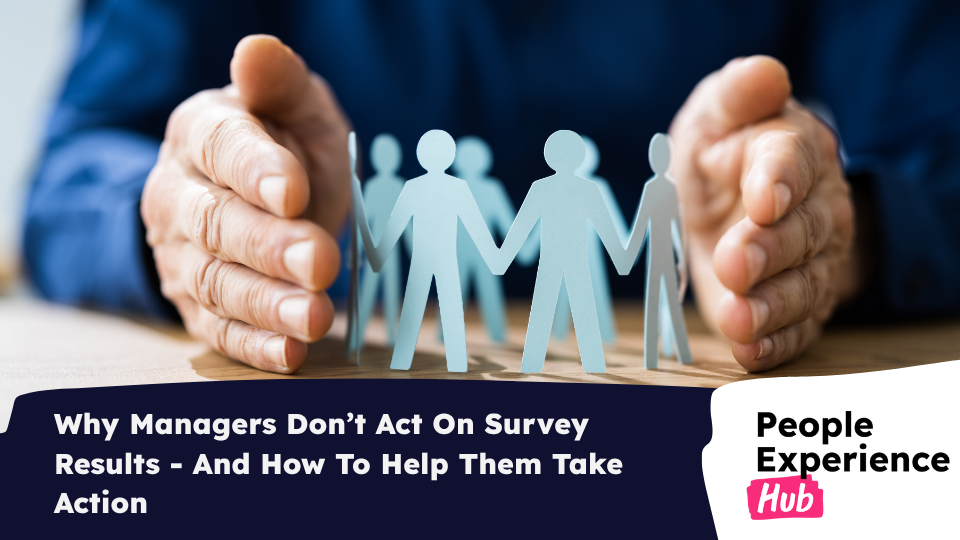 Managers usually want the best for their team, and therefore to act on survey results, but capability, opportunity, and motivation barriers get in the way. By designing surveys for insight, supporting managers with clarity, confidence, and capacity, and removing practical blockers, organisations can close the dataaction gap and unlock meaningful change.
Why Taking Action Is Harder Than It Seems
Employee surveys only deliver value when they lead to change, yet this is the point where many organisations stall, with potentially negative consequences.
In fact, longitudinal research at Pepsico1 and our own experience suggests three things are true:
- Managers that take action see significantly improved results over time (of around 20%)
- Managers that also discuss survey results with their teams do even better (up to 30%)
- When managers do nothing, their results can actually get worse.
The gap between survey results and action – the ‘data-action gap’ – isn’t caused by apathy. It’s caused by friction and behavioural science tells us that behaviour changes when three things come together: Capability, Opportunity and Motivation (known as the COM-B framework2).
So let’s think about some of the behaviours involved in taking action, and what might actually stop them.
Why managers don’t engage with the data
Managers that fall at the first hurdle might not even look at their results or might just glance at them and give up. In our experience, its not because they don’t care but could be because they:
- Don’t even know their results area available amongst day-to-day noise
- See employee survey as an ‘HR thing’, not a ‘management thing’
- Have good intentions but struggle with time and workload
- Run up against technical problems accessing results
- Have had bad experiences with surveys, leading to scepticism
- Are intimidated by data, so they avoid it
What can help
- Clear communication about timelines and expectations
- Strong sponsorship emphasising why surveys and action matter
- Permission to prioritise survey work over other tasks
- Giving very clear user instructions and training, including details of support
- Accessible user guidance and training
- Addressing past survey failures openly and honestly
When managers don’t understand what they’re looking at
Understanding survey data is not as straightforward as we’d like. Even data‑literate managers struggle when:
- Dashboards are unclear, inaccessible, or visually messy.
- Charts don’t tell a story.
- Terminology is confusing or abstract.
- Insights aren’t prioritised or contextualised
While many managers are now data literate, we can’t assume that to be the case. In fact, we surveyed managers last year and only 29% said that they have access to the learning and resources they need for the ‘hard’ side of management.
Design and analytics play a huge role. Managers shouldn’t need to be analysts or engagement experts - the insight should come to them.
What can help
- Surveys designed so create actionable insight (rather off-the-shelf products for awards)
- Clear language and minimal jargon (though it’s not easy so support materials can also help)
- Accessible dashboards (including for colour-blind users).
- Analytics that highlight relationships, drivers, and risks, not just scores.
I’ll mention AI later, but this is an area where AI and Data Science has so much to offer, because when insights are crystal clear, then action becomes much, much, simpler.
When managers don’t know what actions to take
Even with clear insights, managers still have a lot to interpret, such as:
- What’s important in their own context
- Which findings they (or their team) can influence
- Where they need support (and from whom)
- What must be escalated
What can help
If the action planning process starts at the top, then leadership can share what issues are being tackled centrally, then at functional or country level, and so on. This becomes easier if every manager from the CEO down involves their team in discussing results and action.
When managers avoid team conversations
This is where it gets messy and emotional. Managers may avoid team discussions because of:
- Scheduling nightmares (we’ve all looked at calendars and given up, haven’t we?)
- Challenges with remote teams and other barriers (we don’t all work in an office)
- Fear of presenting the results incorrectly (need to look competent)
- Lack of confidence in facilitating the conversation
- Discomfort in dealing with questions or challenges
What can help
Much of enabling managers to have conversations with their teams is about building more general, transferable skills, and it’s also about promoting a psychologically safe environment, but it’s also important to provide:
- A simple conversation structure
- Clear facilitation guidance
- Light-touch training (that’s useful in other contexts)
- Named, human support (e.g. HRBP or L&D partner)
When action plans don’t lead to action
Creating an action plan is the midpoint, not the end of the survey process, and we know that it’s not only on survey action plans that execution falters.
What can help
- Focus on a small number (3-5) of meaningful actions.
- Assign a sub‑team, representing different skills and interests, to drive outcomes.
- Build accountability through visibility (team and manager).
- Integrate actions into performance goals and reviews.
- Use tools that send reminders and track progress.
- Block time for planning, doing, and reviewing.
- Proactively remove practical blockers.
Setting Managers Up for Success Starts Before the Survey Launch
Earlier I mentioned that you can exert effort at the action planning stage, or reduce friction. Friction starts at the beginning of the survey process and can be compounded at each additional stage.
If your survey is:
- Designed for insight
- Communicated and deployed well
- Analysed effectively
- Presented clearly
…then meaningful action becomes much more achievable.
But even the best process won’t overcome one universal truth: overworked, under-supported managers struggle to engage
How AI is changing the equation
AI and data science are now filling gaps that once required time, effort and deep expertise (usually in the form of consultants):
- Designing surveys based on historical insight
- Tailoring communication to different audiences
- Generating clearer, more meaningful insights
- Suggesting action plans
- Coaching managers through team conversations
This is exciting, because it makes once-expensive support, to close the data-action gap, accessible at scale.
Employee surveys only matter when people can see something change because of them.
Our guide shows you how to turn raw feedback into clear conversations, meaningful actions, and long‑term business improvements without overcomplicating the process.
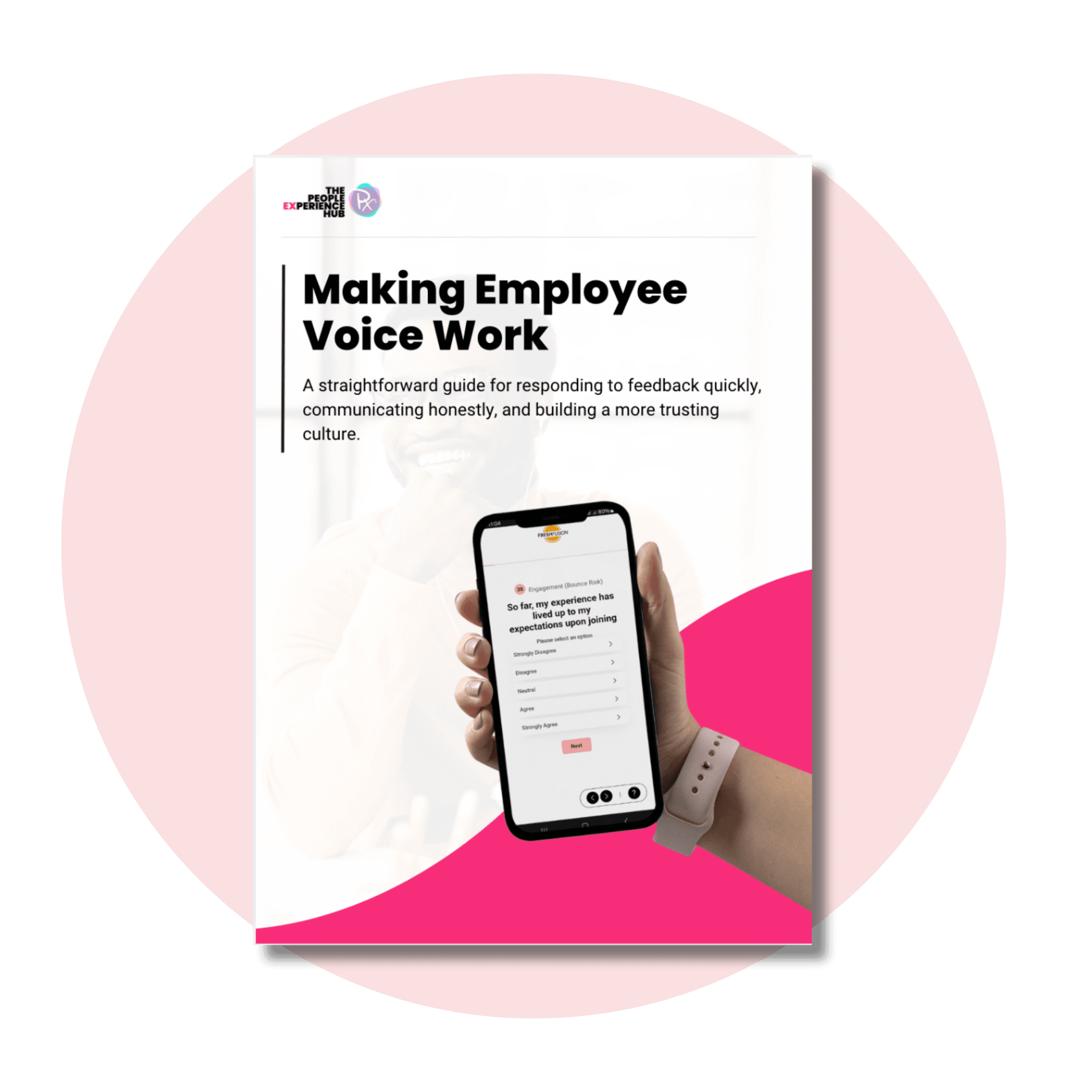
Making Employee Voice Work Guide
A straightforward guide for responding to feedback quickly, communicating honestly, and building a more trusting culture.
Download The Guide
Book a demo to see our platform in action
Enjoy more reads from our Employee Voice, Explained series:
- What Leaders Actually Want After An Employee Survey
- How to move employee feedback into action (without overcomplicating it)
- How to Close the Loop on Employee Surveys Without Overpromising
Church, Allan & Golay, Leslie & Rotolo, Christopher & Tuller, Michael & Shull, Amanda & Desrosiers, Erica. (2012).Without Effort there can be no Change: Reexamining the Impact of Survey Feedback and Action Planning on Employee Attitudes. Research in Organizational Change and Development. 20. 223-264.
Michie, S., van Stralen, M.M. & West, R. The behaviour change wheel: A new method for characterising and designing behaviour change interventions. Implementation Sci 6, 42 (2011).